

Table of contents
One of the trademark qualities of human skin is that it is selectively permeable— meaning, it lets some things in, keeps other things out, and releases still other substances.
Just think about what happens when you're outside in the rain. If you get wet, you don't absorb the rain like a sponge; your skin repels the water. On the other hand, your skin will absorb oil or lotion (water + oil).
Your skin releases the waste product of sweat but not urine, because the two kinds of "water" carry different substances at different stages of digestion. And while we may bemoan the occasional cold or flu, or even more serious illnesses we "catch," we can imagine the infinite substances our skin comes in contact with constantly and be in awe of how much of that doesn't make us sick.
Taken together, these qualities make skin an extremely intelligent barrier that understands its need to cooperate with the many beings in the external world for our individual health.
A holistic skin care routine can’t stop at the surface. Jennifer Kurdyla
With this understanding of skin's function, a holistic "skin care" routine can't stop at the surface. The ways we support digestion, elimination, and immunity from the inside-out all play a role in how our skin looks, feels, and functions.
Key Takeaways
- Skin is selectively permeable — an intelligent barrier, not just a surface to treat with products.
- In Āyurveda, healthy skin is the byproduct of complete digestion; how you eat matters as much as what you eat.
- Skin-friendly foods include richly pigmented produce, watery bitter vegetables, aloe, ghee, and herbs like turmeric, neem, and amla.
- Poor elimination shows up on the skin — blocked digestion pushes āma (waste) out as acne, rashes, and eczema.
- Daily moderate sweating supports circulation, metabolism, and the skin microbiome.
- Ojas, the refined product of good digestion, creates the natural "glow" we chase in expensive creams.
- A simple routine: cool-water rinse and oil moisturizer by day; gentle cleanser and no moisturizer at night.
- Abhyaṅga (self-massage with oil) supports skin, the nervous system, and self-awareness.
- Touch is the only sense humans must have stimulated to thrive — connection is skin care too.
Ayurvedic skin care through Digestion, Elimination, and Immunity
Ayurvedic skin care works from the inside out — here's how digestion, elimination, and daily rituals shape healthy skin.

According to Āyurveda, we "digest" not just edible food, but information, sensory details, and all of the communication, repair, and maintenance processes happening inside and between the cells of your body in one way or another.
At the same time, the tissue of skin itself is the byproduct of a complete digestive process. When we process food properly, the first several layers of our physical body that are formed (lymph, blood, muscle, and fat) contribute to skin's elasticity, porosity, complexion, temperature, softness, nervous conduction, and tone.
Foods With an Affinity for Skin
Ayurveda identifies certain foods that have an affinity for skin, including:
These foods can be incorporated into a balanced seasonal diet, but even more important than what you eat is how you eat.
When we eat in a calm, relaxed environment, at regular intervals throughout the day when appetite is present, with full attention on our food (i.e., no scrolling!), and a relaxed abdomen, our digestive fire (agni) can stay centralized in our guts rather than being dispersed externally. Under these conditions, any and all foods become "skin-friendly"!
Elimination and the Skin

On the other side of digestion is elimination. In a more direct way, skin is one of the body's main pathways of detoxification by releasing sweat (which also acts as temperature regulation), as well as other waste product metabolites (which we feel when we wake up from sleep and want to take a shower).
Āyurveda recommends daily moderate sweating through sauna or exercise (depending on the person and season) as a form of hygiene and "skin care," as it promotes healthy circulation, metabolism, and the skin microbiome.
Sweat can also be an indicator of imbalance. "Healthy" sweat flows clear, freely, and with little to no odor. When sweat is excessive, smelly, or stains clothing yellow, we know that āma, or unmetabolized waste that can contribute to disease, is present.
Āma is produced when what we take in doesn't have the right support to turn into functioning tissue, and doesn't have a pathway out of the body either—so it hangs around and ferments, expressing itself in different flavors of inflammation.
Immunity and Ojas
Regular digestion and elimination also contribute to skin care vis-a-vis immunity. The final and most refined level of the digestive process according to Āyurveda is an immune elixir called ojas. Ojas comes to our aid during moments of disease or stress, but when the body is in homeostasis, ojas gives us the "glow" of health we often seek in expensive creams and procedures.
In modern science, ojas has a correlation in the microbiome. Proper digestion involves "feeding" the gut microbiome, which means our internal immune system can handle any invaders that might get past the skin's barrier; likewise, when the skin microbiome is robust, due to proper hygiene and overall health, it's better able to take care of problematic outsiders before they make their way inside.
Related Product
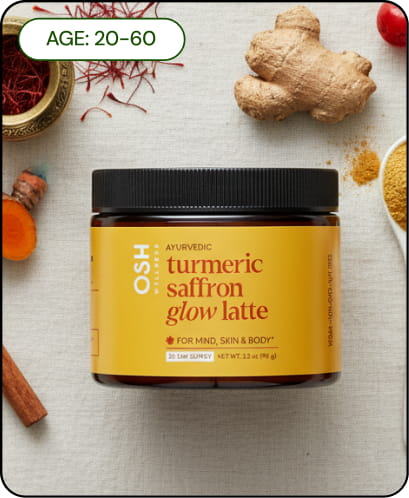
That inside-out glow is exactly what Āyurveda builds with skin-supporting herbs like turmeric. If you'd like a simple daily way to bring them in, OSH's Turmeric Saffron Glow Latte blends turmeric and saffron into a warm, nourishing cup — glow from within, one sip at a time.
Skin Care Strategy
Take cues from your (ideal) eating habits when it comes to skin care routines and products. In the morning, flush away anything that came to the surface during sleep by rinsing the face with cool water (no cleanser). Follow with an oil-based moisturizer that easily absorbs into the skin; you want to "feed" your skin during the day, just like your main meals should be taken during daylight hours. If you'll be outside for more than an hour, apply physical sunblock (e.g., mineral-based, not chemical); otherwise, skip it, since your circadian rhythms are fueled in part by regular sun exposure. In fact, getting sunlight within an hour of waking is an excellent way to support metabolic, hormonal, and cognitive health.
At night, go ahead and wash your face with cleanser. Āyurveda uses oil and grain cleansers, but even more conventional/drugstore cleansers are fine as long as they don't strip the skin of oils and leave it feeling "squeaky clean." Skip the moisturizer at night; it will confuse the body's natural lubrication cycles, and you'll wake up feeling dry, then need more moisturizer, and you'll wind up dependent on products!

Skin as an Organ of Sensory Perception, Mind, and Personal Boundaries
Ayurveda defines health not only at the level of the gross (no pun intended!) body, but also the emotional, mental, and spiritual body—meaning that the digestive, eliminatory, and immune functions of the skin also have to do with more subtle forms of nutrition, processing, and expression. Many of the physical imbalances that affect skin can also be driven by stress that causes mental worry, interrupts sleep, or affects our ability to make good choices for our health. Our ability to "digest" what we pick up from our environment and others around us—and not identify with those external factors—translates into a more subtle kind of immunity also related to ojas and the microbiome.
Abhyaṅga — Self-Massage With Oil
To address this aspect of our "skin care," Āyurveda has a beautiful and truly holistic ritual that supports the skin at every level: abhyaṅga, or self-massage with oil. Using light, rhythmic, and loving strokes to apply oil to the whole body, this practice supports skin through:
Hygiene, since the oil will bind to naturally-occurring oil-soluble waste products
Nervous system support, by releasing tension in the fascia, which lives just under the skin
Self-awareness and energy management, by turning attention inward and creating a stable container for the Self inside the body
Abhyaṅga is safe for most people, but should not be practiced during menstruation, acute illness/fever, or when there are signs of internal indigestion. Also, some people don't like the feeling of oil on their skin, in which case using pure organic aloe gel on the skin is a great alternative, or practicing dry massage to move lymph.
Skin Care Strategy
In addition to regular abhyaṅga in the morning or evening, seek opportunities to give and receive wholesome, consensual, and loving touch with those around you: people, pets, and plants all count! Other forms of self-massage, like myofascial release and lymphatic drainage, are also excellent to support our relationship with our own bodies.
Notice, too, how you are "feeding" your skin through the fabrics you wear and fit of your clothes, exposure to light (which affects mood as well), and general engagement with community.
Feeling "comfortable in our skin" depends not only on how we look externally, but engaging in meaningful activities, having supportive relationships, and making time for rest, relaxation, and pleasure. Touch is the only sense that humans need to have stimulated to thrive, and our modern, high-tech culture is creating an epidemic of isolation affecting our mental health and our engagement in this vital sense.

Written By: Jennifer Kurdyla
Jennifer Kurdyla is an Ayurvedic practitioner, herbalist, yoga teacher, and writer based in Brooklyn, New York. Committed to sharing the ancient tools of Ayurveda and yoga with modern communities, she helps her clients and students discover personalized rituals that support their well-being in body, mind, and spirit.
A former book editor and graduate of Harvard University, she is the co-author of Root & Nourish: An Herbal Cookbook for Women's Wellness (Tiller Press, 2021), and author of the forthcoming book, Sense-Care is Self-Care: Ayurveda & Yoga for Mental Resilience. Read more about her holistic health services and educational resources at www.jenniferkurdyla.com and on Substack.
Disclaimer
The statements in this article have not been evaluated by the Food and Drug Administration. Any product mentioned in the article is not intended to diagnose, treat, cure or prevent any disease. This article is not medical advice and is not meant for every situation. Every person's body is different and may respond differently to supplements, remedies, or treatments.