

Table of contents
Understanding the Doshas: The Ayurvedic Foundation for Women's Health

Ayurveda, the traditional healing system from India, acknowledges that the body possesses infinite wisdom. It teaches us that everything in nature is made up of the five elements: ether, air, fire, water, and earth. These break down to express the three doshas. We know them as Vata, Pitta, and Kapha. Vata is composed of the ether and air elements and mostly expresses the qualities of dry, light, cold, rough, and mobile. Pitta is the dosha of fire and water elements, and largely expresses hot, sharp, light, and dispersing qualities. Then, Kapha dosha is made up of earth and water elements and expresses heavy, cold, slow, dense, cloudy qualities. No two women's bodies are the same. Each woman must be looked at as a unique individual with a unique pathway back to optimal health. Ayurveda shows us how to map out this path.
We start by understanding her Prakruti, her unique Ayurvedic constitution. We consider what the ratio of doshas is at the time of birth as well as in the current time. Then, we consider the root cause of the imbalance. Just because a woman is approaching menopause does not mean she will definitely experience vaginal dryness. And, just because she is experiencing vaginal dryness does not necessarily mean she is in menopause. This is where the skill of an experienced Ayurvedic Doctor or Practitioner comes in. They can help identify the exact causes of imbalance and outline a clear path forward towards optimal health and radiance.
When we remain in balance with the cycles of nature, listen to our body's signals and trust the body to heal itself, balance of the body, mind and consciousness is inherent.
What Causes Vaginal Dryness in Perimenopause and Menopause?
In the context of perimenopause, menopause and post menopause, we can consider why vaginal dryness in menopause occurs. In a relatively healthy and balanced body, the vaginal secretions and other bodily secretions are ample. The hormone estrogen promotes suppleness, juiciness, and vitality.
When a woman reaches her midlife or menopausal transition years, it can seem like all of a sudden, qualities of dry, light and rough can appear. She is stepping into the Vata stage of life, regardless of whether or not she has more Vata, Pitta or Kapha in her foundational constitution. The ancient Ayurvedic scholar Charaka described a condition called Suska Yoni — the traditional Ayurvedic understanding of vaginal dryness in menopause and beyond. Suska means dry and Yoni refers to the female reproductive organs.
Symptoms of Vaginal Dryness and Vata Imbalance

Due to the impact of dropping hormone levels and the change in the doshas, the dry quality may increase in some individuals, and they may notice dryness of the skin, the eyes, the mouth, the joints, and even the vaginal area. She may also feel spacey or ungrounded, have difficulty sleeping, and experience strong emotions.
If vaginal dryness persists, the tissues become less flexible, and a woman may experience painful intercourse, a burning or itching sensation while urinating, and repeated UTI's. These are symptoms that are not comfortable or acceptable long-term.
The Ayurvedic Principle for Treating Vaginal Dryness Naturally

Whenever an imbalance presents itself, we can think about the concept of like increases like and opposite qualities balance. This is one of the foundational principles of Ayurveda. For example, when the quality of dryness is increased, we would want to bring in the opposite qualities of wet, oily, and unctuous. We can specifically think about bringing in those qualities through hydration, the foods we eat, the herbs we consume, and our daily practices.
In my Ayurvedic practice, I have seen many of my clients resolve concerns of vaginal dryness by following daily, simple Sadhanas, or self-care practices.
Optimize Hydration to Combat Dryness
It is not only consuming fluid, but also holding on to it that is helpful.
Think about adding a squeeze of lemon or lime, a pinch of sea salt, and ½ tsp honey to your beverages, drinking hydrating teas such as cumin-coriander-fennel seed tea, tulsi tea, or even just plain water. Coconut water contains natural electrolytes and is very hydrating.
Remember to stay hydrated!
Reduce Stress to Lower Vata Dosha
Simply put, increased stress leads to an increase in Vata dosha, which leads to an increase in dry quality. It is significantly helpful to offset the effects of stress every day. The Pranayama practices Nadi Shodhana (alternate nostril breathing) and Bhramari (bumble bee breath) directly dissolve stress and bring the nervous system into balance. Vedic wisdom teaches us that moment-to-moment awareness prevents stress from impacting us. Meditation is the most effective practice for this.
Best Foods for Vaginal Dryness: A Vata-Pacifying Diet
Overall, you will want to consider following a Vata pacifying diet. It is best to avoid foods that are excessively dry, cold, raw, and packaged. Eating sweet, juicy fruits, root vegetables, warm stews, and healthy fats increases the unctuous quality and offsets the dry quality. Excellent examples are berries, sesame seeds, pumpkin seeds, almonds, dates, sweet potatoes, avocados, ghee, and olive oil.
Why Shatavari Is the Most Recommended Ayurvedic Herb for Vaginal Dryness
During times of hormonal transition, in Ayurveda, we often recommend rejuvenating and moistening herbs such as Shatavari root. It is known as a soothing and demulcent herb that restores juice to the body. Shatavari is recommended for women of all stages of life to balance hormones and promote this supple quality. It is especially recommended when vaginal dryness occurs.
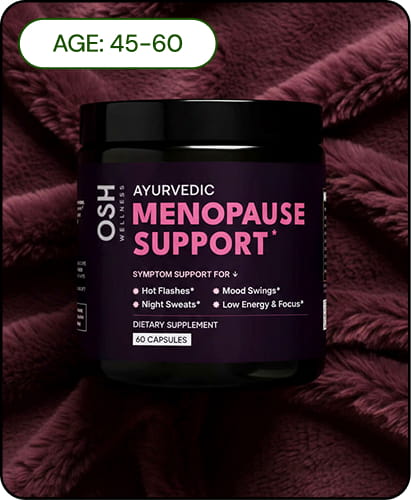
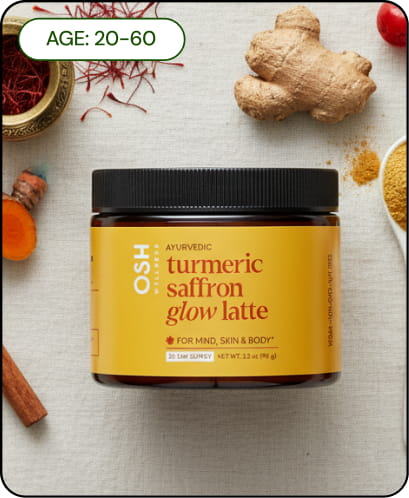
Shatavari can be taken in different forms, but an easy way to consume it is to mix ½-1 teaspoon of Shatavari powder with one cup of warm milk and spices. You can also enjoy the Turmeric-Saffron Glow Latte by Osh Wellness. All you need to do is add Shatavari powder. The Ayurvedic Menopause Support formula by Osh Wellness also contains Shatavari and is formulated with synergistic herbs to counter vaginal dryness. These blends will start to restore hormonal balance and have a moistening effect throughout the body over time.
Shatavari is called Rasayana, or an adaptogen herb, overall supporting vitality, resilience, and hormonal balance. Shatavari is also beneficial to balance the menstrual cycle, may enhance fertility, and supports ample breast milk production. It is an aphrodisiac that is highly effective in nourishing and rejuvenating the reproductive system and whole body. The Sanskrit word, Shatavari, literally translates to: she who has 100 husbands.
Please note: Shatavari root is generally considered safe and well-tolerated. It contains phytoestrogens which offer gentle yet effective support to the physiological decrease of endogenous estrogens, thereby potentially alleviating hot flashes, mood swings, insomnia, dryness and other typical hormonal disturbances. It is an anabolic or building herb, so it is best to avoid it if you have a history of breast cancer or other growths.
Aloe Vera Remedy for Pitta Types
Another Ayurvedic remedy that is moistening and cooling and great for Pitta types is aloe vera.
You can mix 1/4 cup of aloe vera juice with 1/4 cup of pomegranate juice and drink this twice daily, between meals.
Natural Lubricants for Vaginal Dryness: Shatavari Ghee and Oils
There is a traditional Ayurvedic formula called Shatavari Ghrita, or Shatavari ghee. This is available through various Ayurvedic companies, or you can make your own. It can be applied inside the vagina or as something classically used in Ayurveda, known as Yoni Picchu. Ask an experienced Ayurvedic Doctor Practitioner for instructions on Yoni Picchu. You may also safely apply coconut or sesame oil around the vaginal opening.
Daily Ayurvedic Practices for Long-Term Relief
Maintaining a regular routine throughout your day helps to sync your internal rhythms with the rhythms of nature. Prioritizing regular meal times and sleep times is key to this. You can also practice self-abhyanga, massaging your body with warm sesame oil. This sacred self-care practice restores lubrication to the whole body and calms the nervous system. You may also consider doing Yoni strengthening exercises, such as mula bandha and Kegel exercises. Reducing busyness or rushing around may significantly pacify Vata dosha and counter the dry quality throughout the body. These are some of the direct ways we can preserve our juice.
It is through moment-to-moment conscious awareness and daily practices that the body can gradually and steadily be brought back into its unique state of balance. When this occurs, the wisdom available in this stage of life unfolds like a flower and benefits everyone around you.

Written by : Sarah Kruse
Sarah Kruse is an Ayurvedic Practitioner (Ayurveda Doctor Level Certified) and has been serving women and their families for 26 years. Sarah helps her clients return to their optimal state of health by integrating the timeless principles of Ayurveda into their modern lives through Ayurvedic Consultations, Coaching, Panchakarma Retreats and seminars.
Sarah specializes in women’s health & hormones, digestion & nutrition, weight balancing, sleep support and cleansing & detoxification. She believes that when you help the body return to its innate state of balance, the body can completely heal itself. Sarah will meet you exactly where you are. You will complete your session feeling cared for and nourished.
She is a graduate of The Ayurvedic Institute in New Mexico, where she studied under Dr. Vasant Lad. Sarah has also traveled extensively throughout India, studying with renowned Ayurvedic doctors and scholars. Her other great loves are her teenage daughter, Amulya and her Australian Shepherd, Luna.
Read more about Sarah and her offerings at: https://embrace-ayurveda.com/
Disclaimer
The statements in this article have not been evaluated by the Food and Drug Administration. Any product mentioned in the article is not intended to diagnose, treat, cure or prevent any disease. This article is not medical advice and is not meant for every situation. Every person's body is different and may respond differently to supplements, remedies, or treatments.